125AD As – Hadrian

125AD As Emperor Hadrian Obverse

The 125AD As - Hadrian

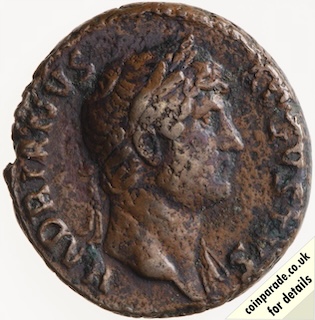
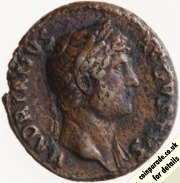
Copper As of Emperor Hadrian, struck around 125AD-128AD. Diameter 26mm and weighs 10.96g.

The Obverse shows the laureate head of Hadrian facing right. Legend is "HADRIANVS AVGVSTVS".
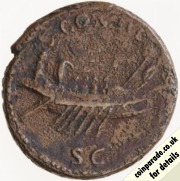
The Reverse shows a ship with rowers, sailing to right. COS III above (showing Hadrian was in his third term as Consul). Letters "SC" below.

SC means senatus consultum, or by 'decree of the Senate' so the coin was an official issue.

Image credit: Museums Victoria

Mintage: Not known
Minted at Roman Mint
More information (monarch, year, mint, country, category) can be found below coin listings.

Below are some coins currently being offered on eBay. As an eBay Partner, We may be compensated if you make a purchase.
List items on:

ROMAN COIN SILVER DENARIUS OF HADRIAN, 1 OF THE 5 GOOD EMPERORS SEPT 1.23
£ 141.10
Roman Sabina Silver Denarius Coin Wife of Hadrian,
£ 99.50
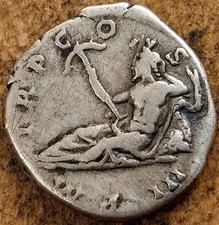
HADRIAN AR Denarius “Travel Series” – NILVS /Nilus with Hippopotamus – Rome Mint
£ 229.50
Ancient Roman Hadrian Silver Denarius - PIETAS - RIC 13
£ 104.70
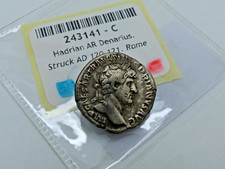
Hadrian Silver Denarius 119–122 AD – Roma Seated with Victory & Spear – RIC 77
£ 94.30
Roman Empire - Hadrian - AD 117-138 - Silver Denarius - NGC Ch F - RIC:864
£ 185.00
Hadrian AR Denarius – RIC 15 – Concordia Very Fine Roman Coin Ancient Genuine
£ 79.74
Hadrian Denarius Travel Series Italia Type Rome Mint C.130-133 AD RIC 1542
£ 83.90

List items on:

Hadrian (Emperor 117AD-138AD)
Classification: Roman Emperor, Roman Imperial (96-235AD)

Hadrian [CAESAR PVBLIVS AELIVS TRAIANVS HADRIANVS AVGVSTVS] was Emperor of the Roman Empire from 117 to 138, a long reign of almost 21 years. He was born Publius Aelius Hadrianus on 24 January 76 and died 10 July 138 (aged 62). He was married to Vibia Sabina. Regnal name Caesar Traianus Hadrianus.

Hadrian is probably most famous in the UK for the building of Hadrian's Wall in the north of England.
Category: Roman
The Roman Empire was one of the largest Empires in history, covering most of Europe, Britain, parts of Asia, the Middle East and North Africa. It was in existence from 27BC to 476AD, more than 500 years. And all these places used Roman coins throughout the era.

Originally coins were minted only in Rome, but by the third Century there were mints in other countries too. These mints sometimes produced more than 2 million coins per month to meet demand. Coins typically depicted the Emperor on one side and some other image or letters on the other. During the Empire, more than 10,000 different types of coins were created using copper, silver and gold.

Roman coins are usually classified as:

- Roman Republican Coins (about 300BC - 27BC)
- Roman Imperial Coins (27BC - 96AD)
- Roman Imperial Coins (96AD - 235AD)
- Roman Imperial Coins (235AD - 476AD)
- Roman Provincial Coins

The Denarius was the standard Roman silver coin and there were a range of others. As a guide, in the early republic (after 211BC) there was the Sestertius (=4 denarii), Dupondius (=5), As (=10, a tenner), Semis (=20), Quincunx (=24), Triens (=30), Quadrans (=40), Uncia (=120) and Solidus (=1000, it was gold). Values fluctuated later due to debasement and inflation.

The exchange values were as follows:
1 gold aureus = 25 silver denarii
1 silver denarius = 16 copper asses
1 brass sestertius = 4 copper asses
1 brass dupondius = 2 copper assses
1 copper as = 2 copper semisses (or 4 copper quadrantes)

The standard gold coin was the Aureus and was equal to 25 denarii or 100 sestertii. It's not far off the weight of a modern gold sovereign. The Aureus was introduced by Julius Caesar around 49BC and was the principal gold coin until about the 4th century when it was replaced by the gold Solidus.

The great part of this is that you can put together a really nice Roman coin collection with very little money, as many coins (although not all) are common and inexpensive. The coins are the best part of 2000 years old and are exciting to collect.

For more information see our articles:
Which Mint: Roman Mint
The origins of the Rome mint are from the manufacture of a silver coin near to the Temple of Juno Moneta back in 269BC. Juno was the personification of money.

Due to the size of the Roman Empire, Rome could not produce all the coins needed and Roman mints were set up in 27 locations, and there were more than 600 provincial mints scattered about the Empire. During overseas campaigns, Generals such as Caesar and Marc Anthony would mint their own coins to pay their armies.

Mint marks were used on the coins to differentiate the mint of manufacture.
Country of Origin: Roman Empire
The Roman Empire ran from 27BC to 476AD and was the post-Republican period of ancient Rome. It covered a large territory of Europe, Northern Africa, and Western Asia. It was ruled by an Emperor.
Try the Roman page on eBay UK
As an eBay Partner, We may be compensated if you make a purchase.